A fifth grader on a tour of his future school stopped abruptly as he walked through the lobby of Vallivue Middle School in Caldwell.
“That’s a swastika!” he said to a classmate with wide-eyed alarm. He was studying one of the dozens of poignant projects created by eighth graders in Raul Pedraza’s social studies class lining the school’s lobby. And he knew enough to understand the symbol did not belong in a school hallway.
Vallivue’s secretary was monitoring his class’s procession along the hall and quickly spoke up.
“We learn about the Holocaust here,” she said. “It’s part of a project you’ll learn more about next year.”
“Oh,” he said with some relief on his face as he moved on. “Cool.”
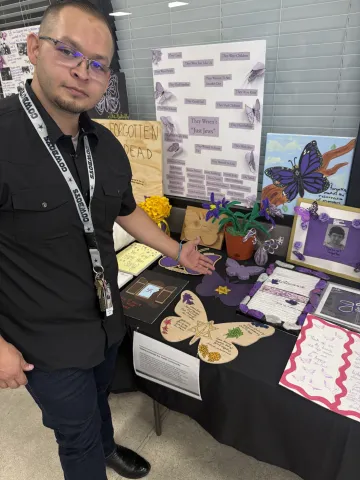
That brief moment is exactly why Pedraza, an Idaho Education Association member and the union’s 2025 Sam Cikaitoga Service Award winner, guides his students through this project and takes over the school lobby to display their work each year.
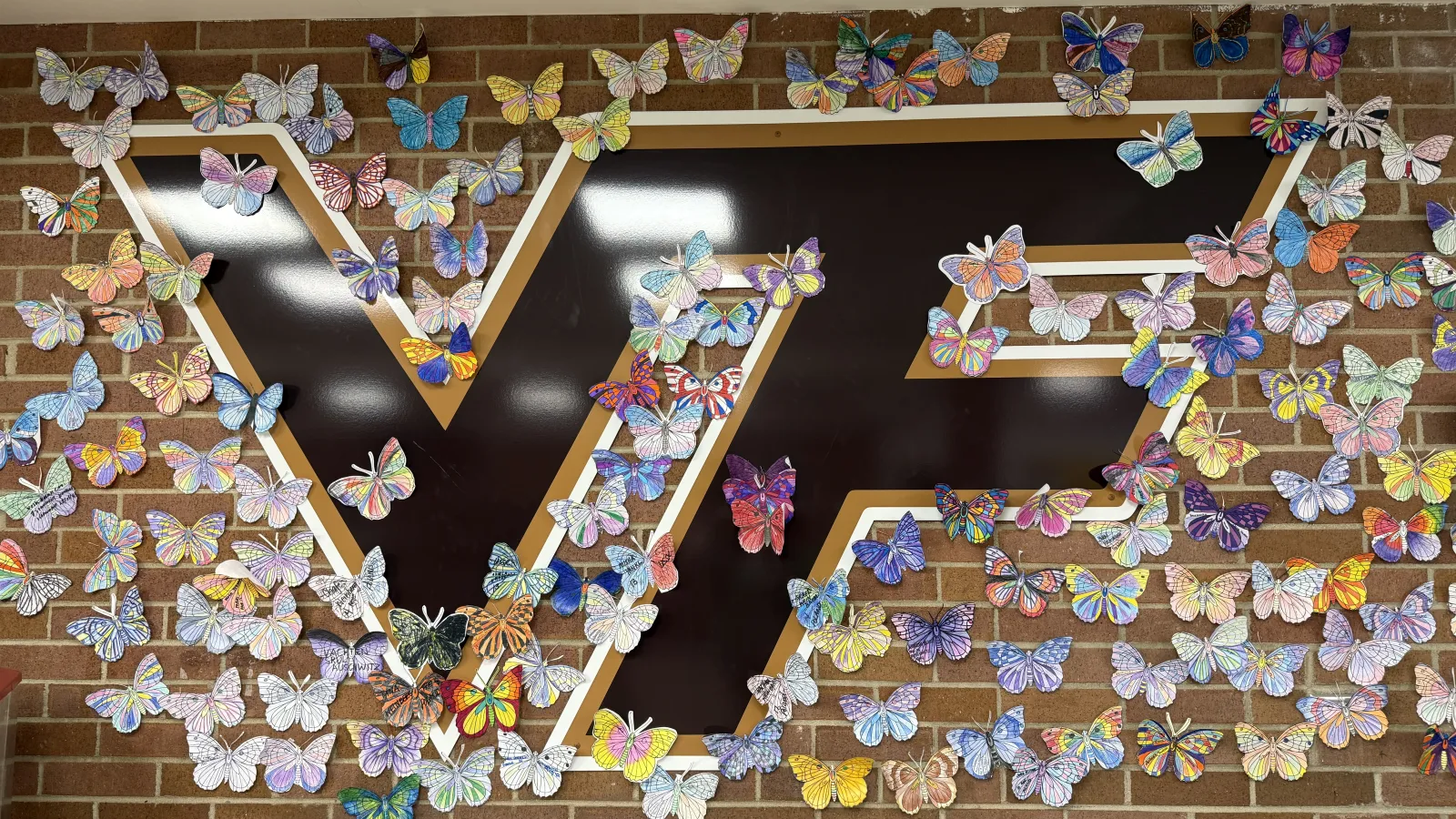
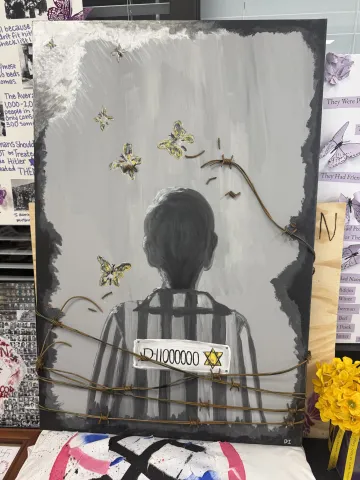
Paintings line the walls. Butterflies hang from displays. Poems, portraits and handmade memorials tell stories of lives interrupted by hatred and violence. One student welded a butterfly sculpture from metal. Another framed the face and story of a Holocaust victim. Nearby, a painting of a child behind barbed wire stops visitors in their tracks.
Every piece was created by an eighth grader.
“I use it as a lesson of: Don’t be a bystander,” Pedraza said. “You want to stand up for victims of bullying, because that’s what the Holocaust was. It was bullying that blew up into murder.”
Every spring, Pedraza dedicates several weeks to teaching students not only about World War II and the Holocaust, but also about the warning signs that allow hatred and dehumanization to escalate.
“I think it’s important that students recognize the various stages that lead up to the mass murder of millions of people,” he said.
The annual project has become one of the most anticipated traditions for the school, drawing students, staff, families and community members into a deeply personal encounter with history. This was the eighth year Pedraza’s students have transformed the Vallivue’s lobby into a public Holocaust exhibit.
His students study the rise of Nazi Germany, anti-Jewish laws, propaganda, ghettos and concentration camps. But Pedraza also asks them to think critically about how ordinary people respond when injustice begins to take root.
“Something as simple as, pay attention to how we refer to other humans,” he said. “The minute we start using words that are dehumanizing, that’s a red flag.”
At the heart of the project is an effort to make history deeply personal.
Using materials from the United States Holocaust Memorial Museum, Pedraza gives each student the identity of a real Holocaust victim or survivor. Students follow that person’s story throughout the unit, then write “I Am” poems from that individual’s perspective.
“That’s kind of how you connect with history,” Pedraza said.
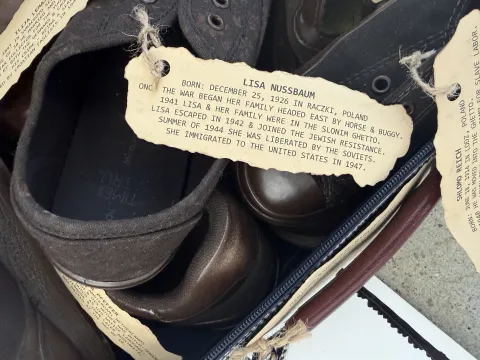
Students are then asked to create an original piece of artwork or memorial project reflecting what they learned. Pedraza intentionally leaves the assignment open-ended and asks students to complete much of the work on their own time.
The results are often remarkable.
Butterflies appear throughout the exhibit every year, inspired by a poem written by Pavel Friedman, a young prisoner in the Terezín ghetto who wrote about never seeing another butterfly again. Over time, Vallivue students have embraced the butterfly as a symbol of the children murdered during the Holocaust.
Vallivue Middle School Principal Tara Daniel loves the annual project and says it’s a schoolwide experience that resonates far beyond the classroom. Every year, the display draws visitors from across the district and community.
“They are consistently amazed by the creativity, thoughtfulness, and depth of the projects our students create,” Daniel said. “For many visitors, it is also a very emotional and powerful experience that leaves a lasting impact.”
The project’s impact is felt even among students who are still years away from Pedraza’s classroom.
Usually, Daniel said, sixth graders first encounter the exhibit with curiosity and excitement. By seventh grade, many are already looking forward to participating themselves.
“It is common to hear comments such as, ‘I can’t wait to do this next year,’” she said.
Pedraza hears the same thing.
“I’ll have sixth graders and seventh graders, when they finally come to my class, they’re like, ‘When are we doing that project?’” he said.
The exhibit has also sparked personal connections among staff at Vallivue Middle School.
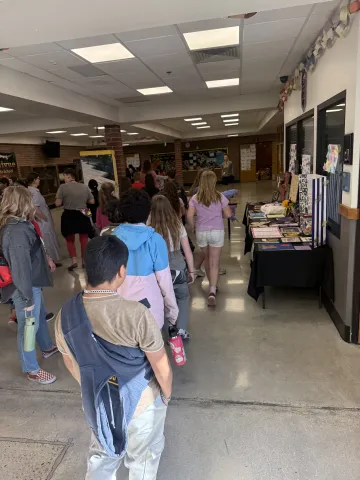
While Pedraza was showing IEA Reporter around the exhibit, his colleague, Elizabeth Hatch, walked up and began sharing the story of her grandfather, Steen Fischer, a member of the Danish resistance during World War II. He helped smuggle Jewish families out of the country in fishing barrels before eventually being captured and imprisoned in a concentration camp.
“Stories like his remind us that history was shaped not only by evil, but by ordinary people who made extraordinarily brave choices,” Hatch said.
Hatch said projects like Pedraza’s matter because they move students beyond memorizing facts and encourage them to emotionally connect with history.
“Displays like Raul’s are powerful because they make students pause long enough to emotionally connect with history rather than simply memorize it,” she said. “That emotional connection is what creates empathy, perspective and hopefully the courage to stand up for others in their own lives.”
The exhibit has also drawn support from the Wassmuth Center for Human Rights in Boise, which partners with educators across Idaho to support human rights education.
“What stands out about Mr. Pedraza’s project is the depth of student engagement,” said Jess Westhoff, education director for the Wassmuth Center. “We believe that when young people genuinely encounter history — not just memorize facts, but grapple with it — they develop the empathy and critical thinking that makes them better citizens today.”
Westhoff said Holocaust education remains especially urgent as fewer survivors remain alive to tell their stories firsthand.
“The Holocaust didn’t begin with concentration camps,” she said. “It began with language, with the dehumanization of people through words and stereotypes.”
When students learn about those patterns, she said, they begin to recognize the warning signs of injustice in their own communities. And often, she added, middle school students approach those lessons with a kind of honesty adults sometimes lose.
“When an eighth grader says, ‘How could people let this happen?’ that’s not naïveté,” Westhoff said. “That’s moral clarity.”
For Pedraza, moments like that are the reason the project matters.
“Eighth graders get a very bad reputation for being apathetic,” he said, “and the Holocaust is a reminder that these kids do have a heart and do have the capability of being empathetic beings.”
The exhibit’s impact goes far beyond the Vallivue lobby now. Teachers bring students through the display during the school day. Other classes contribute butterflies and artwork. Families work alongside students at home. Families and community members stop to quietly read poems and survivor stories hanging in the hallway.
Which is exactly the point, Pedraza said.
“It’s everyone’s responsibility to remember and learn from it.”