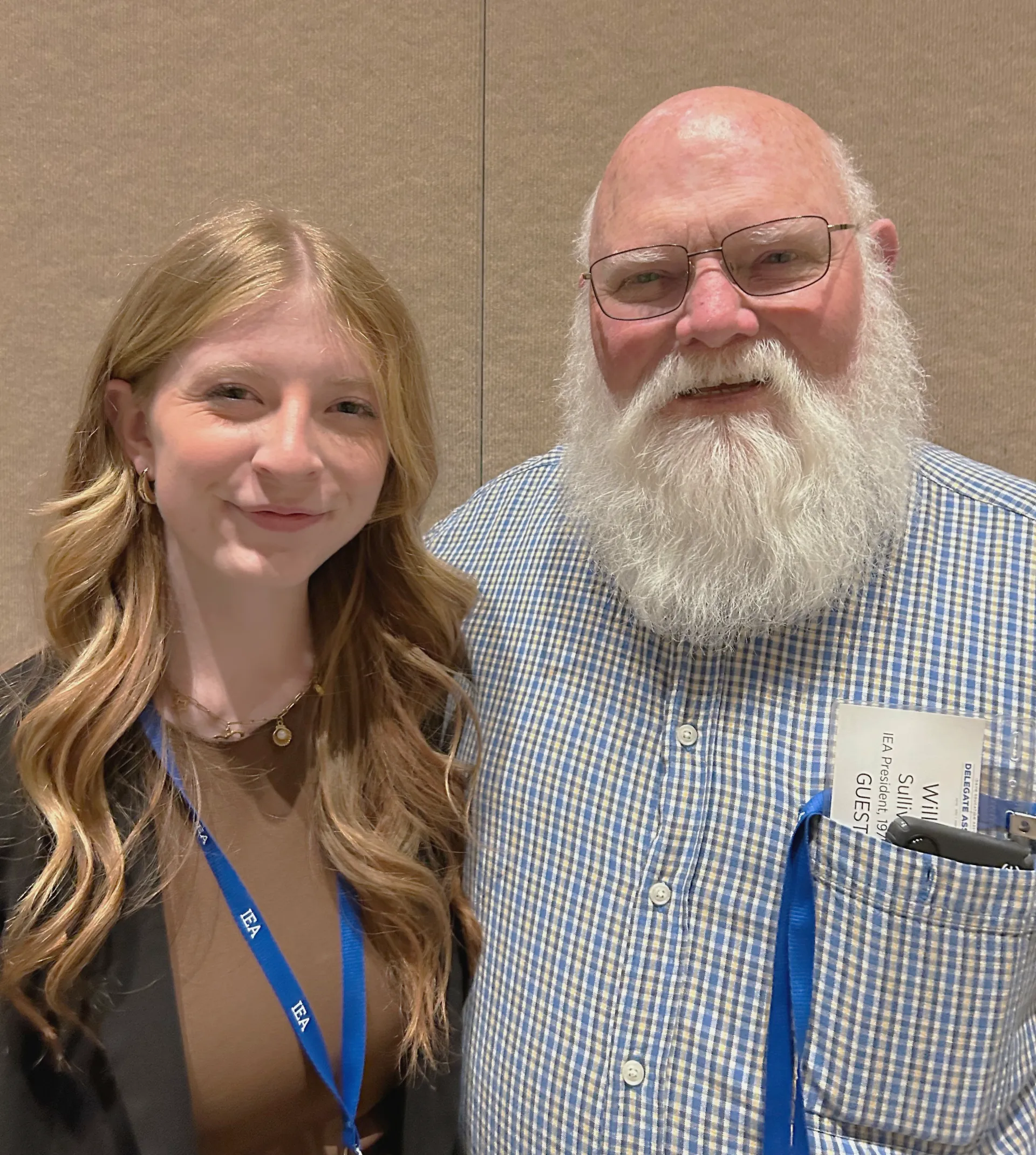
When former Idaho Education President Willie Sullivan was recognized from the podium among the past presidents in attendance at this year’s Delegate Assembly, he took a point of personal privilege to share the spotlight with someone close to him. His granddaughter, Kelsey Smith — a Boise State University education student who has helped revitalize the university’s Aspiring Educator chapter — was a first-time delegate. Sullivan couldn’t be more proud to point her out in the crowd.
“It’s kind of beyond my wildest dream,” he said of Smith later that day. “She’s so bright and so caring and it just — my heart couldn’t be any more full than watching her, because she’s an amazing person in many, many respects, not just as an educator.”
Sullivan and Smith’s attendance did more than just highlight the many members for whom education is the family business. It also brought out Sullivan’s fighting spirit. This year’s DA came just a week after Gov. Brad Little signed House Bill 516, the anti-union bill that limits conversations and collaboration in members’ workplaces.
“We’ve got to stand up,” Sullivan said. “Enough is enough.”
Standing Up Is a Family Tradition
Their family tree is dotted with educators and public school supporters, including Sullivan’s brother, uncle, nephew, niece and daughter-in-law. Sullivan’s twin sons grew up wearing the hand-me-downs of the twin sons of Smith’s paternal grandmother — who was, of course, also an educator.
“So a lot of educators all around,” Smith said, laughing.
Smith knew early on that she would be an educator, too. She came across an old notebook recently where she had drawn out a school schedule. Her stuffed animals were her students.
It would be an understatement to say the family stands up for public education in Idaho. Smith remembers tagging along with her mother, a school board member, to protest the Luna Laws in the 2000s.
It’s a fight Sullivan had been waging since 1969, when he joined IEA. There is an anti-education streak in the Idaho Legislature that has been present for as long as Sullivan can remember. Years ago, when he and IEA argued to keep educators on the Idaho Department of Education’s Professional Standards Commission — which makes recommendations to the State Board of Education about ethics and certification standards — a legislator pushed back.
“I literally had a state representative say to me, ‘We don’t need people that are professionally educated,’” he remembered. “ ’I had an eighth-grade education. That’s all I needed.’ ”
That’s an attitude educators still encounter in the halls of power. “I don’t think that’s the sentiment of the entire Legislature,” Sullivan said. “But I think there’s a very significant element of anti-education people involved in the Legislature, and there has been for a number of years. And it’s been growing — this whole anti-education, anti-vaccination, anti-everything sentiment that’s out there. It’s scary, but we’ve got to stand up. We’ve got to say enough is enough.”
When Sullivan later became an administrator in Payette (he kept his union membership, even as an admin), he had to tell educators in the Title I district to stop coming in on Saturdays. He saw their dedication. Sullivan began recruiting educators the way a coach recruits athletes, he said, promising competitive pay and professional treatment — an unusual move.
His approach was built on a basic building block for any profession. He referenced a famous political slogan from the Clinton era: “It’s respect, stupid. No one is respecting teachers the way they should be respected. It’s the most noble profession out there. It’s the first profession that is only caring about people.”
A First-Timer Uses Her Voice
For Smith, her first Delegate Assembly was a revelation.
“I think it’s so awesome,” she said. “It’s really cool to be able to hear everyone’s different perspectives and really hear the individual voices, and know I’m not the only one fighting for this cause and fighting for public education. I feel like I’m learning a lot more about the IEA and the union in general.”
She is already grappling with a reality that greeted her grandfather in the 1970s: educator pay in Idaho. When she tells people she would like to stay in the state and teach at a Title I school, the responses are discouraging.
“Every time I talk to a teacher … their first response is, ‘Don’t do it in Idaho,’ or ‘Don’t do it at all,’” she said. “Like you have to move somewhere else. I had one teacher tell me that I needed to be married before I went into my career if I wanted to be able to sustain being an educator in Idaho. And I think that while those concerns are valid and probably true and it is difficult, the state needs to recognize how difficult they’re making it and understand that these are people’s livelihoods and things that really do matter.”
Time to Get Louder
Although their careers are decades apart, Sullivan and Smith agree on the direction of IEA, especially after the passage of House Bill 516.
“I just think we have to get louder,” Smith said.
Sullivan knows about being loud. He organized two marches on the Capitol, one in 1980 and another in 1984. In 1980, the march was preceded by Christmas cards to every legislator, following by letters printed on blue stationery, dubbed “The Blue Blizzard.” The march itself was organized so every legislator could meet with their own local delegation in staged meeting spots around the Statehouse.
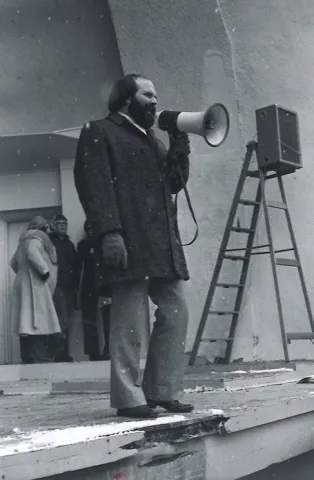
“It wasn’t just a show of force,” he said. “It was a show of intention. That we’re not just here to make noise, we’re here to follow through, and if you don’t do something to help educators and to fund education, this won’t be the last of us.”
Idaho educators can’t take much more, he said. “I think we have to say: We can’t keep doing this,” he said. “We can’t keep getting kicked when we’re down. We can’t keep having people call us names. We can’t be having people accuse us of ulterior motives. We can’t be having people tell us we aren’t doing a good job when they don’t know what we’re doing.”
This is something that cuts across party lines, Smith said. “Education, no matter what, is a bipartisan issue,” she said. “Kids from Democrat families, kids from Republican families, kids from Green Party or independent families — all those kids are going to school, by law and also because it’s good for them. Understanding the importance of education for every type of child, no matter what political beliefs they have, is something that I think people should recognize and talk about more.”
Sullivan backed her up. “The Legislature is telling us that politics are going to run your life,” he said. “They’ve made those decisions for us. They want to make us think we’re the problem. We aren’t the problem. We’re the solution.”
That much was evident at Delegate Assembly, and it was clear Sullivan and Smith were in their element as a family passionate about education. “My wife gets mad at us because we talk shop at the dinner table,” he laughed.
Smith said she wouldn’t have it any other way. “I’ve always been surrounded by this culture and love for education,” she said. “I’ve always known that it’s hard, but I think it’s something that’s very important.”
Sullivan beamed. “It fills my heart to see her do what she’s doing,” he said.