The big opportunity: Summer Institute registration opens on April 17 — register now for four days of professional development taught by educators, for educators.
• This year’s theme is “Clues to Excellence: Unlocking the Secrets of Success.”
• Summer Institute 2026 will take place from July 28-31 at Lewis-Clark State College in Lewiston.
• It’s free for members — including lodging and meals — and participants can earn up to four professional recertification credits through Idaho State University.
Your sneak peek: We spoke with four educators who will teach classes ranging from behavioral issues to time management to bringing women’s history to life.
Know Your Rights and Value as an ESP
Meet the trainer: LiseAnn Mills, a Mountain Home Education Association member who serves as the education support professional at-large on the Idaho Education Association Board of Directors, is teaching four classes this year that are geared toward ESPs:
• “ESP Professional Growth Continuum”
• “ESP Rights in Public Schools”
• “Unlocking Potential: ESP and Teacher Collaboration”
• “Behind the Behavior: Understanding, Presenting, and Intervening,” which Mills will co-teach with Alex Walker of the Boise Education Association.
What you’ll learn: Besides her popular legal rights class and her real-world tips for developing great working relationships with students, Mills is excited to share the ESP Professional Growth Continuum (PCG).
• Mills has been trained in this specialized framework developed by the National Education Association, which covers eight universal areas and three skill levels ESPs should know and be able to accomplish.
• The goal is to help ESPs level up with training designed by ESPs. “It’s an outline of how I can better do my job,” Mills said about the PCG. “That helps make my evaluations better. And in some districts, that can lead to a raise.”
• The continuum is also tailored by job category, Mills said, which means a behavioral health aide won’t receive the same suggestions as a food service worker. “These aren’t just blanket suggestions,” she said.
Why training others is important to her: “It’s a chance for me to give back, because I know ESPs are not recognized as much,” she said. “There’s not a lot of professional development for them. … But ESPs are just as important as teachers, and they need to be able to take classes that are relevant to their job and what they need.”
Why she loves Summer Institute: “It’s an environment that is uplifting to everybody, and it doesn’t feel like, ‘Oh, I have to be here,’” she said. “People are there because they want to be there, they want to take classes, and it’s a whole different atmosphere than a regular PD from your school.”
Bring Women’s History Alive In Your Classroom
Meet the trainer: Mary Anne McGrory of the Pocatello Education Association, a middle school social studies teacher, is bringing lessons from powerful trainings she has attended.
• “Picture This: Unlocking the Power of Picture Books in Secondary Classrooms”
• “Teaching the Holocaust K-12”
• “Where Are the Women?”
What you’ll learn: Repeat attendees might recognize McGrory’s picture books and Holocaust classes, but “Where’s the Women?” is new this year.
• “It deals with the fact that … only 13% of history books are about women, and that leads people to believe that women didn’t have an effect on history — which could not be further from the truth,” she said.
• McGrory developed the training after earning a fellowship for a New York Historical Society program called Women and the American Story. “Where’s the Women?” combines primary sources, life stories, videos and artifacts into modules that educators can plug into their lessons. Women from every state are featured, including Idaho’s own Polly Bemis — and the information is also divided by topic for easy reference.
Why this training is meaningful to her: McGrory recalled being a child and learning more at her public library about women’s role in history than she did at school. “I want my female students, my Latino students, my Native American students to see themselves in history, because they were part of it,” she said. “Their history is our history, and this website really provides the opportunity and ability to do that — I just want to share it.”
Why she loves Summer Institute: McGrory attends Summer Institute with her daughters, who are also educators, and they use the event as an opportunity to transition into the back-to-school mindset. “What I absolutely love is that it’s by us, for us,” she said. “It’s people who work in the state, who know the state, and they know what other teachers and paras and ESPs are going through.”
Create Brave Spaces and Better Classrooms
Meet the trainer: Alex Walker, an ESP and Boise Education Association member, works with some of the most behaviorally challenged students in her district. She’s also a powerful advocate within the union — and she’ll be bringing both areas of expertise to Summer Institute in her trainings
• “Behind the Behavior: Understanding, Presenting, and Intervening,” which Walker is teaching with Mills.
• “Teaching Democracy Through Dialogue: Fostering Civil Discourse and Brave Conversations in Grades 6-12 Classrooms,” which she is teaching with Sarah Jones of the Cassia County Education Association.
What you’ll learn: Walker, who is earning her master's degree in social work, learned about a framework called the “mountain of escalation” that maps escalating student behaviors to appropriate adult responses. But it’s not just about identifying and managing student behavior, she said. She’ll also be talking about the responsibility educators bear themselves. “We can’t ask a kid to regulate or meet us where we’re at if we ourselves aren’t regulated,” she said. “That’s where it’ll always start.”

• Walker’s civil discourse class introduces the concept of moving from a “safe space” to a “brave space.” “We’re not going to make everyone comfortable all the time,” she said. “There’s no growth that happens, there’s no meeting each other where we’re at if we’re making everyone comfortable.” The goal is to give educators the tools to allow productive disagreements and help students use their voices effectively.
Why these topics are important to her: Both classes connect directly to what Walker witnesses every day with her students. “It’s not wrong to want something different or to ask for something different, but you aren’t going to see change unless you know how to show up to those conversations in a way that others will hear you out,” she said.
Why she loves Summer Institute: “Summer Institute was the first thing where I was like, ‘Oh, my gosh — I get to learn and have fun?’” she recalled. One of her favorite moments was taking a ghost tour of Lewiston at night with other members. “Now I have friends in the union across the state because I went to Summer Institute, and that’s really cool.”
Explore Games, Dyscalculia and the Art of Saving Time
Meet the trainer: Carmi Scheller, a member of the West Ada Education Association who also serves on the IEA Board of Directors, is one of Summer Institute’s most enthusiastic regulars. This year, she’s teaching three sessions:
• “Dyscalculia Introduction and Next Steps for Supporting Mathematical Learning Differences”
• “A Planning Detective: Uncovering Time-Saving Strategies in Chalk”
• “The Games People Play: Using Games for Learning — Strategies Across Ages and Subjects,” co-taught with Angie Hickman and Kirsten Glover of the West Ada Education Association.
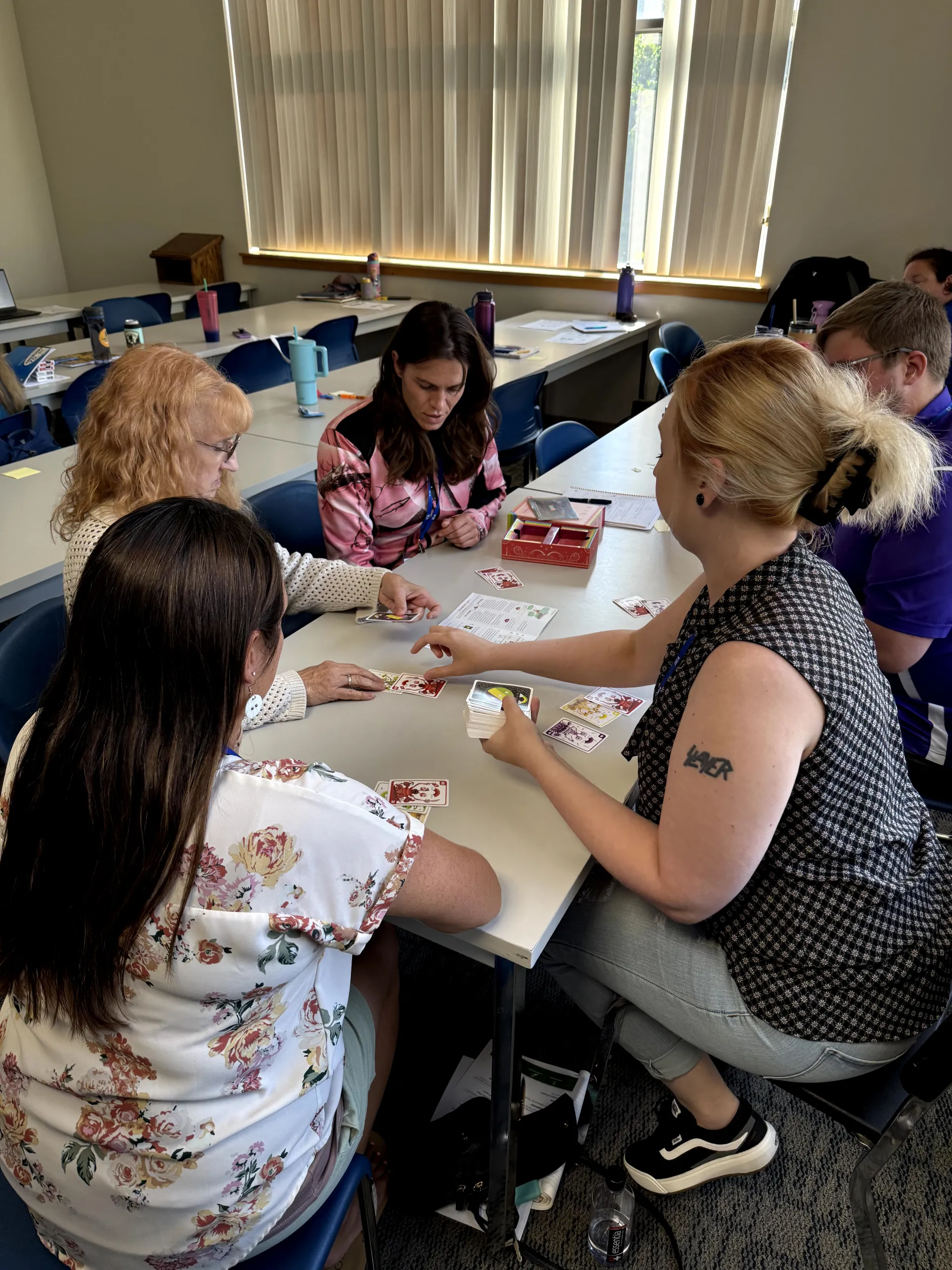
What you’ll learn: The popular games class taught by Scheller, Hickman and Glover is back for another year of hands-on engagement and fun. Games offer a perfect route to increasing socialization, Scheller said. “With games, it’s natural, and kids don’t feel forced to interact,” she said. “They just do.”
• Her Chalk session will offer hacks she has developed while using the lesson planning platform to automate and streamline her workflow. Invest in the initial set-up time, she said, and you’ll enjoy the payoffs throughout the school year.
• Scheller’s dyscalculia class emerged from the dyslexia training the union has developed — she found herself wondering what she could do to help students who struggled with math. “I invested some time and learned more about dyscalculia, and found a name for what I’ve been seeing through years and years and years of teaching students with math challenges and ways to approach them,” she said. Dyscalculia presents as severe difficulties understanding numbers, time, doing mental math and more. This class builds upon the dyscalculia course she taught last year, adding more support through visuals and materials.
Why she’s teaching at Summer Institute: “It’s like someone who has perfected a recipe,” she said of the educators who teach during the event. “They’re sharing the best recipe with you instead of the beginner recipe that was OK, but it wasn’t great. You’re getting the great stuff.”
Why she loves Summer Institute: Scheller, who also serves on the Summer Institute Board of Directors, loves the enthusiasm among educators (as anyone who has witnessed her reacting to door prizes, “Price Is Right”-style, can attest). And if you’re not up for attending in person, you can get a sampler in your own home. “There is the online option,” she said. “It’s not as many days and not as many courses, but that’s a way to check out some of the PD. Dive into that course catalog and dig around!”
Bookmark the Summer Institute Page
You'll want to have it handy when registration opens! Learn more and be among the first to sign up on April 17.