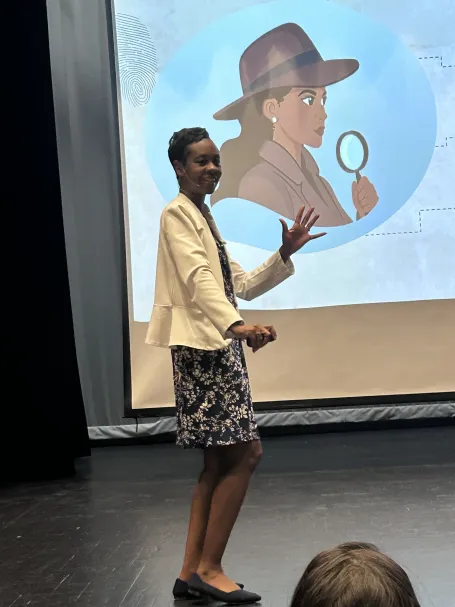
The speaker: Monica Washington presented the SI keynote speech Tuesday at Lewis-Clark State College in Lewiston.
• Washington is the teacher quality director for the National Education Association
• She was 2014 Texas Teacher of the Year and was inducted into the National Teacher Hall of Fame in 2023.
The setup: Taking advantage of the Summer Institute theme, “Clues to Excellence,” Washington presented “cases” of three types of students most educators encounter every year.
• The interactive presentation included prompts, discussion time with other educators, share-outs — and a lot of laughter.
How she got here: In 1998, Washington took over a seventh-grade classroom from an educator who left mid-year. Her first students were blunt, telling her: “You’re not doing any work,” she remembered. “We run everybody away.”
• She was robbed by a student and had to testify in court, and even had a student jump out of a classroom window (he didn’t suffer any injuries).
• Washington quickly realized that the “other duties as assigned” in her job description meant “figuring things out and making stuff when you had nothing to make it with,” she said.
Her ‘cases’: It can be tough trying to “crack the case” on some of the quietest, least engaged students in class. But once you do, Washington said, magic happens.
• The Invisible Student: This student hides behind their hair or a hoodie and stays so silent that it’s easy to forget they’re in the room. The solution: Small, consistent reach-outs to let the student know they are seen and appreciated. Washington would often leave sticky notes on desks (one student collected every note she received over two years) or deliver a poem featuring answers from students’ intake forms, making sure every student was represented.
• The Uninspired Student: They don’t seem to engage at all, preferring to daydream or to sleep. Many times, Washington said, the solution is as simple as filling a physical need, like giving a snack to a student who isn’t eating enough at home. Or perhaps the student is a different type of learner and needs choices about what to focus on next, or more space to design their own project to demonstrate their learning.
• The Different Personality: Sometimes, students appear to be very different people in the classroom compared to outside the classroom — silent in their seats, but the center of attention among their friends. It could be that they aren’t engaged, or it could be that they haven’t learned how to have a conversation in a class setting. Try asking them a random question, Washington said: “Is a hot dog a sandwich?” Sounds silly, but it breaks them out of their shell.
The union angle: Long before she worked at NEA, Washington used what she saw in the classroom as a chance to improve student outcomes.
• “We talked about organizing, but I didn’t know what that was,” she remembered. “I just knew that I saw problems, and I wanted to point problems out.”
• Putting your teaching in the context of your school’s mission and values helps frame innovative teaching methods for admin, she said. “Tie what you want to do to those and it’s so hard to let them tell you no,” she said. “That’s my secret.”
Watch Washington's Keynote
Get inspired by the speech that galvanized Summer Institute attendees.