Published: January 9, 2026
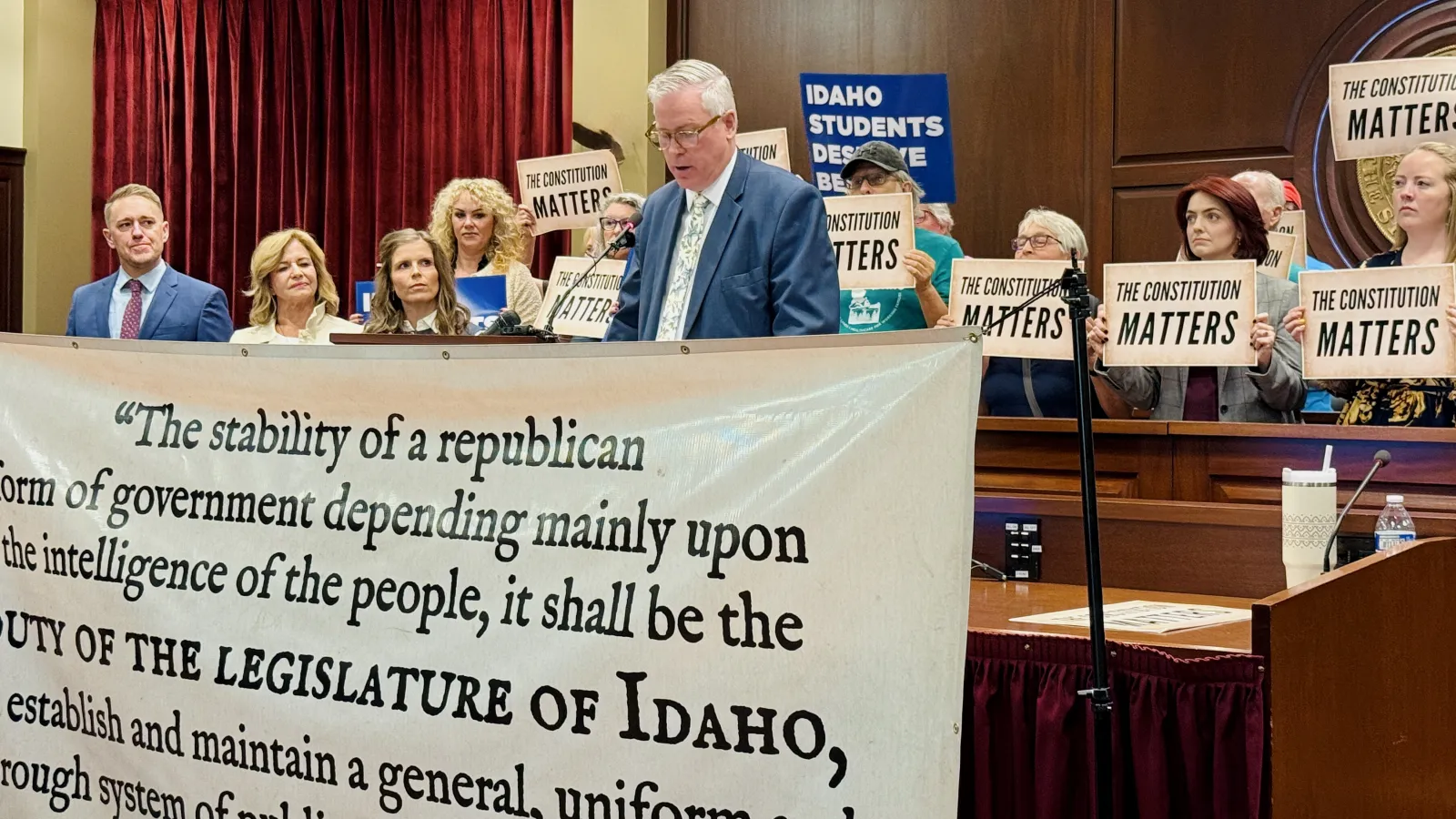
Idaho Education Association Executive Director Paul Stark speaks during the press conference announcing a lawsuit challenging the state's voucher law.
Ending the Era of Private School Vouchers Before It Begins
No matter how the Idaho Supreme Court rules on vouchers, IEA will fight to keep public dollars in public schools.
The background: After years of near misses, anti-public education lawmakers finally succeeded in bringing a private school voucher program in Idaho: $50 million in taxpayer funds for private school tuition and expenses.
• House Bill 93 created a tax credit voucher program to be administered through the Idaho Tax Commission. Parents of students who attend private school are now eligible to receive $5,000 per child in publicly funded tax credits, or up to $7,500 per child with a disability.
• Parents may begin applying for vouchers on Jan. 15, 2026. We don’t yet know how many people will apply, but backlash against the bill was swift and vociferous — and has continued steadily throughout the year in the form of town halls and wave after wave of public opinion pieces.
• In September, IEA and other petitioners asked the Idaho Supreme Court to rule HB 93 unconstitutional because the scheme creates a parallel taxpayer-funded school system in direct violation to the Idaho Constitution. As of the publish date, IEA is waiting for a hearing to be set or the court’s ruling to be handed down.
The hurdle: Forces inside the Legislature and beyond its walls may affect the fate of HB 93.
• There is a lot of money riding on the success of private school vouchers — as evidenced by the swarms of out-of-state lobbyists that packed the halls of the Statehouse last year during the legislative session.
• Just as IEA members warned during the last legislative session, the combination of deep tax cuts and a new voucher program has ravaged the state budget — just as it did in Arizona, which Idaho legislators used as a model for the state’s program.
IEA’s position: Private school vouchers are bad for students, bad for schools, bad for communities and bad for budgets.
What to watch: The Supreme Court’s ruling is expected in late January or early February, just as the Legislature is setting future budgets for public schools. “No matter what the court rules, IEA will continue to fight the advancement of any and all voucher legislation during this session,” said IEA Executive Director Paul Stark. “Every dollar earmarked for vouchers is a dollar that could be put to excellent use in the public schools that serve more than 90 percent of Idaho students.”
• Voucher expansion — an idea some legislators have already floated — could be a difficult sell in a year with a state budget shortfall.
• President Trump’s “one big, beautiful bill,” which passed earlier this year, contains a federal voucher program. It remains to be seen whether Idaho legislators will opt into the federal program — which could replace or supplement Idaho’s existing voucher program.
National Education Association
Protecting Educators from Violence
The Idaho Legislature doesn’t have a great track record for developing clear-eyed solutions to the problem.
The issue: Educators around the country are experiencing violence at the hands of students and even parents — and Idaho is no exception.
• IEA members were asked in a survey this year whether they have experienced classroom violence. More than 1 in 4 said they had within the past year.
• According to a new report from the National Education Association and the American Psychological Association, 56 percent of teachers, school psychologists, social workers and counselors experienced physical violence during the 2021-2022 academic year.
The hurdle: It’s generally acknowledged there is a problem — but the Legislature has not agreed on a way forward.
• Rep. Ted Hill (R-Eagle) introduced legislation in 2024 and 2025 to allow educators to carry concealed weapons, calling schools “a soft target” for mass shooters. That, however, disregards the everyday violence educators face.
• Rep. Chris Mathias (D-Boise) has tried to pass legislation that would require parental notification for serious bullying but failed in both 2024 and 2025. Another Mathias-sponsored bill that would have clarified safety language, including emergency procedures, was held in committee.
• That leaves other institutions to work on piecemeal solutions. In August, Idaho State University received a $4.5 million grant from the U.S. Department of Education to defray costs for school psychology majors who commit to serving in high-need K-12 districts.
IEA’s position: IEA members have been at the forefront of demanding protection for educators and better mental health support in schools.
• As Central Idaho Education Association President Valary Pfefferkorn told a recent meeting of the Mountain View School District board of trustees, “We have staff being hurt, feeling hopeless, developing mental and emotional disorders, and on the constant verge of quitting every week,” she said. “I watched a kindergarten teacher have to leave campus to cry after her classroom had been destroyed for the third time in a single day. I’ve sat with multiple teachers in my classroom as they cried and begged me for help. Just today I watched a staff member, whom I have never seen upset, break down and cry in the hallway after school. I personally have recurring nightmares because of a violent student in my classroom.”
What to watch: Keep an eye out for legislation related to violence in classrooms by following IEA Reporter. Every week, we’ll keep tabs on the discussions and proposed legislation on this issue.
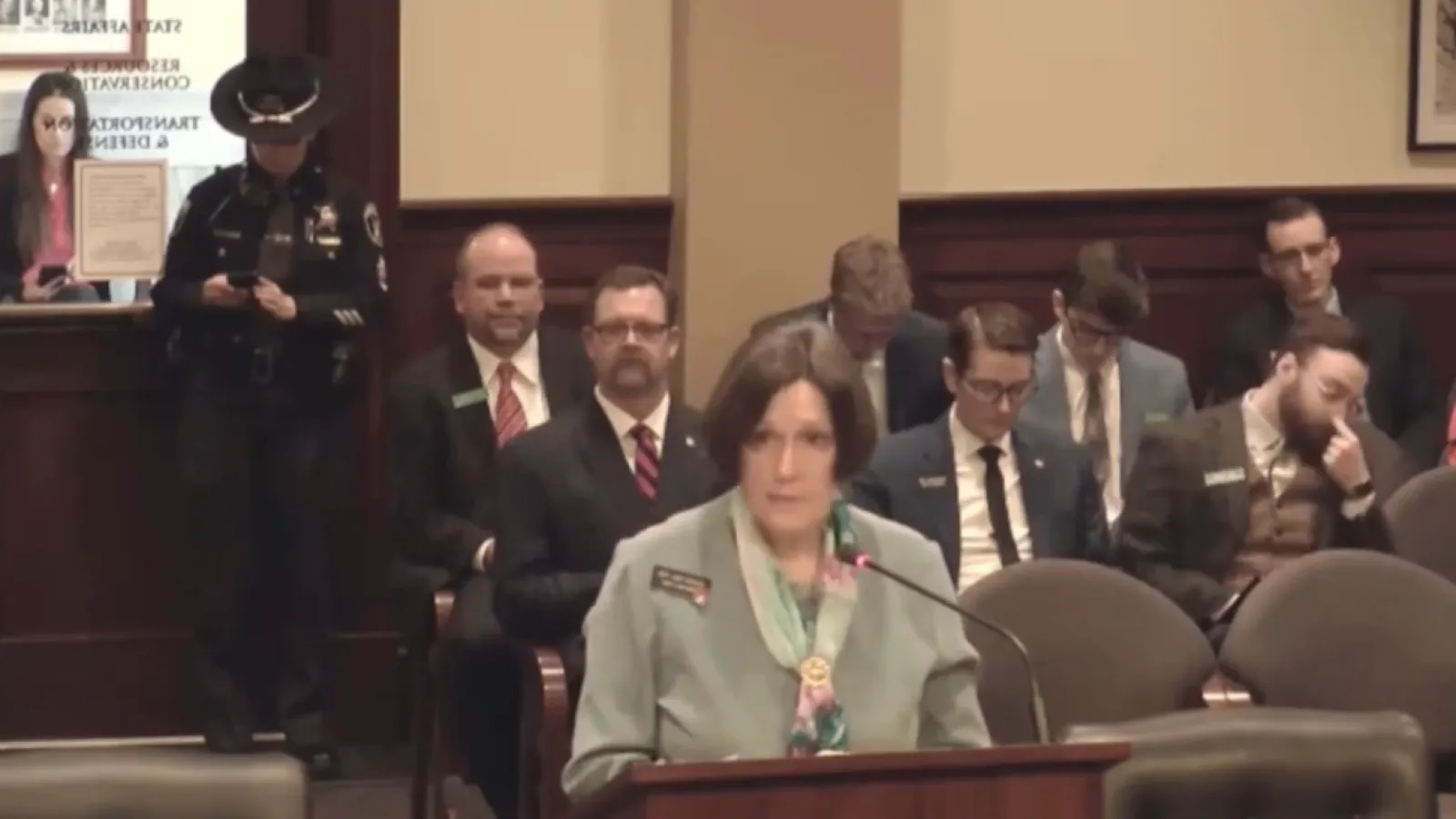
Rep. Judy Boyle (R-Midvale) presents her union busting bill in 2025.
Union Busting Will Be on the Table, Again
Anti-union lawmakers are expected to put forth yet another piece of cookie-cutter legislation.
The background: Another legislative session, another attempt to roll back the power of public-sector unions.
• For years, anti-union lawmakers in Idaho have tried to deny workers’ rights to unionize and participate in collective bargaining: Idaho became a right-to-work state in 1985, followed by repeated attempts to end payroll deduction for union dues.
• In 2025, Sen. Ben Toews (R-Coeur d’Alene) and Rep. Judy Boyle (R-Midvale) sponsored a bill that would have stripped public school districts’ ability to collect union dues on behalf of union members through payroll deduction — a tactic that has been used in other states to gut unions overnight.
• IEA wasn’t the only one targeted in 2025. Rep. Rob Beiswenger (R-Horseshoe Bend) attempted to deny firefighters their right to negotiate their own workplace safety conditions.
• Why do they hate unions? Boyle pointed — without evidence — to supposed “under the table” dealings between IEA and school districts. Beiswenger said firefighter safety should cut out firefighters entirely and leave such decisions to elected officials.
The hurdle: Anti-union thinktanks churn out endless legislation to stamp out unions and disperse it via lobbyists to statehouses around the country. In 2025, Utah educators lost their ability to collectively bargain — along with police officers, firefighters, and other public employees.
• Utah’s law was overturned just this week, but only after months of confusion and expense. Others are still fighting the ramifications of legislation years after the fact.
IEA’s position: Unionized employees enjoy better pay (12.8% more) and workplace safety protections — measures that are especially valuable to firefighters and educators who work with special needs populations.
• "This isn’t the first time we’ve faced threats from Idaho legislators, and it likely won’t be the last,” said IEA Executive Director Paul Stark. “But every time we have faced an anti-union threat, IEA members have rallied in solidarity. Legislators try to target us because of our strength — and that strength is a muscle we will flex every time.”
What to watch: Expect more of the same from Boyle, Beiswenger and Toews, and possibly Rep. Dale Hawkins (R-Fernwood). Idaho legislators aren’t exactly known for paying attention to lessons from other states, such as the politically expensive one Utah is currently learning.
• It will be interesting to see whether lawmakers target public-sector unions beyond education. So far, the Fraternal Order of Police is the only public-sector union that has escaped lawmakers’ attention.
Get more from
Want more content? You can stay up to date on the latest with the IEA Reporter newsletter. Sign up to stay informed.
We are Idaho's public school educators.
As Idaho's largest labor union, we advocate for Idaho's education professionals and work to unite our members and the state to realize the promise of a public education that prepares every student to succeed. Together, our voice is stronger.