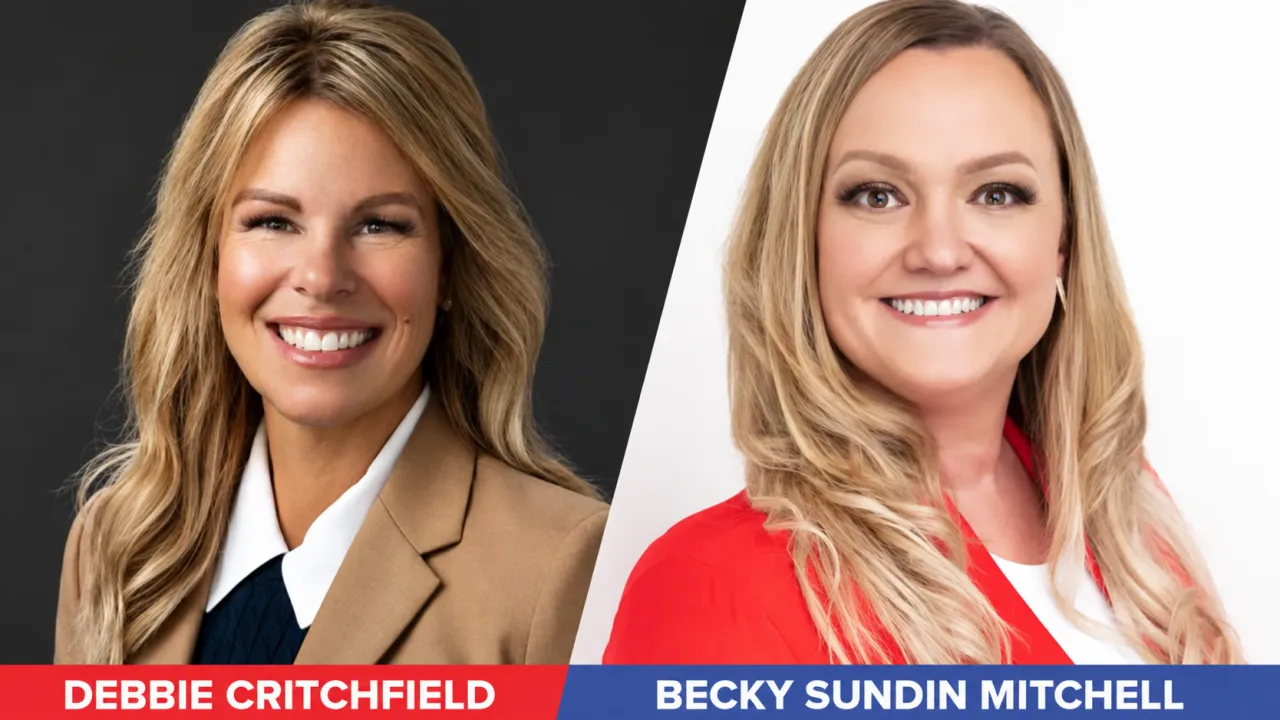
The debate: Idaho’s top candidates for state superintendent of public instruction, Republican Debbie Critchfield and Democrat Becky Sundin Mitchell, faced off Tuesday at the College of Idaho in a debate that covered topics ranging from the funding formula to AI.
Why it matters: Idaho perennially ranks near the bottom nationally in per-pupil spending, and Idaho’s fluctuating revenue counts have made budgeting difficult at both the state and district level. Whoever wins will shape how the state faces tough choices around money, vouchers and politics in classrooms. Here’s where the candidates land on top issues.
School Funding Formula
Idaho’s funding formula dates back decades, and both candidates agree it is broken. They just disagree on the fix. Currently, the funding formula is based on attendance rather than enrollment.
• Sundin Mitchell wants a move to enrollment-based funding: “The funding formula was created the year I graduated high school,” she said. “It’s a long, long time ago, and so we need that to reflect current numbers.”
• Critchfield would like an approach that doesn’t solely focus on enrollment. “If we only tie everything to enrollment, we are going to unnecessarily cause damage in other parts of the state while we’re trying to fix a different problem .... it may all come down to enrollment, it may not, but we need to run through what those scenarios look like.”
Private School Tax Vouchers
Lawmakers created a $50 million tax credit in 2025 to subsidize private school tuition.
• Critchfield would not say whether she supports or disapproves of the tax credit, but she does fault the bill: “The current bill in place did not achieve two very important standards that I have for any taxpayer dollars, and that would be transparency and accountability.”
• Sundin Mitchell pointed out that families already have choice in the form of charter schools. “But taxpayer dollars going to any sort of private school is strictly against the Idaho Constitution,” she said. She continued, referencing the Idaho Constitution’s Blaine Amendment: “We should not have a system that takes taxpayer money and channels it into private school, even with accountability.”
Special Education Funding
Earlier this year, the Idaho Legislature approved a $5 million fund for high-needs special ed. This year, Critchfield is reducing her ask for the fund to $1.7 million. The debate over special ed funding became more charged when Sundin Mitchell, the parent of a special-needs child, said that federal special ed leadership had made inflammatory public comments about autism.
• Critchfield says the dollar figure is not a crisis. “The costs are already expended,” she said. “Whether or not the state puts $1 or $5 million in there, those costs must be expended by the school district.” She said a revised funding formula would be the real fix.
• Sundin Mitchell said her child, who later attended Boise State’s engineering program, was initially nonverbal and needed assistance — but that assistance was only possible with funding. “(Teachers) are staying until 6 and 7 o’clock at night, filling out paperwork, hoping to get some Medicaid funding,” she said. “It couldn’t be a more broken system.”
Property Taxes
Thanks to the chronic underfunding of public education, the burden of funding public schools often falls to the local community in the form of property taxes. The state Republican platform calls for eliminating property taxes entirely.
• Sundin Mitchell says there is “no way” to take away funding for public schools in the form of property taxes without replacing it, but “it’s always on the back of the average person, and we know that we recently just gave a tax break to the very wealthiest here in Idaho,” she said. She added: “The reality is, everybody needs to equally support public schools.”
• Critchfield agrees that the state needs a plan. “I would only support a removal of the property tax if there was something to replace it, wholesale replacement,” she said. “Without it, it would be a devastation to our local school districts.”
Student Mental Health
Both candidates agree there is a mental health crisis among students. But they have different ideas on how to approach it.
• Critchfield would like firmer boundaries for schools. “Teachers aren’t therapists, and we shouldn’t expect them to be,” she said. “And we can’t expect the schools … to be in a position where they’re solving every single issue, particularly related to mental health.”
• Sundin Mitchell would like mental health professionals embedded in schools to help with what she calls “the anxious generation.” She can see students behave differently than they did when she began her career: “I, as a teacher, have received little to no professional development on how to deal with this.”
AI in Classrooms
The state recently issued AI guidelines for districts, but the candidates disagree on whether they are enough.
• Sundin Mitchell said the state is “woefully behind” the ball on standards. “These are not going to keep pace with where we see AI going in schools,” she said.
• Critchfield said the new standards are intentionally flexible. “The guidelines are truly guidelines,” she said. “What this is going to look like will depend upon your local district or charter.”
Measuring School Success
Should students’ learning be gauged based on standardized tests or growth over time?
• Critchfield said her office has pushed for broader metrics than standardized tests, including whether students go on after high school: “We see more students entering employment or enlisting, and so when we talk about employ, enlist or enroll, those are three very important metrics that we can point to as a mark of success for our students.”
• Sundin Mitchell said her experience in the classroom has made her skeptical of standardized testing. “If we’re going to have measures that show that a school is successful, it should be measurements of growth, not on one test that’s given at the end of the year and on a grade level that’s often decided by the state.”
Politics in the Classroom
Both candidates agree, in theory, that politics should be out of schools.
• Sundin Mitchell said the focus should be on the child, and educators should be trusted to teach, saying that politics has “zero role in education.” Educators should “be allowed to take approved curriculum and teach it, and they will teach it to the best of their ability.”
• “I can absolutely be a leader in the conversation so that we’re prioritizing what schools are there to do,” Critchfield said. “We’re here to teach. We’re here to learn. That’s where we want to start. Social issues: Is this a good thing for kids, or if it’s not, how are we going to work through it?”
Teacher Retention and Union Busting
The candidates were asked directly whether House Bill 516, which targets Idaho Education Association activities specifically, is good or bad.
• Sundin Mitchell said she did not approve of the bill. “It’s a bad law for teachers, and the reality is, when you have a bad law for teachers, it affects everybody.”
• Critchfield would not commit to calling the law good or bad, instead focusing on the fact that the law did not eliminate collective bargaining: “We want local leaders to be able to negotiate with those teachers,” she said. “If that can still happen, and some of the rules around how that happens got changed, then we’ll work through that.”
What’s next: The Idaho Education Association will announce its candidate endorsements for November’s General Election in the coming weeks. Stay tuned to IEA Reporter to discover who the IEA’s Political Action Committee for Education Committee supports for state superintendent.