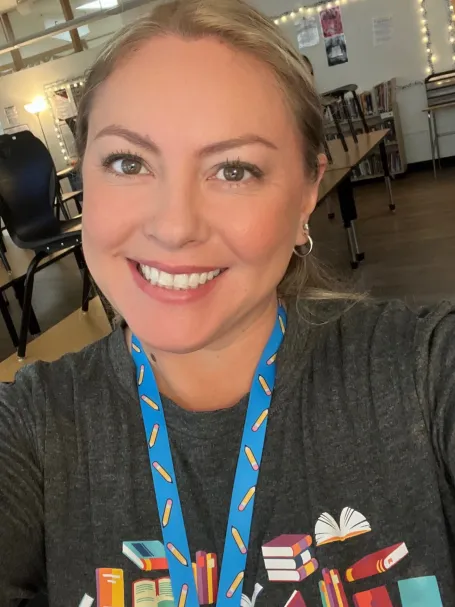
Tiffanie Bird had a problem: Her Cheshire Cat wouldn’t appear.
It was opening night for “Alice in Drama Land,” a play the Moscow Education Association member had written for her students at Moscow Middle School. Her Cheshire Cat had been one of Bird’s shyest thespians at the beginning of the semester, but she had the drive and ambition for one of the play’s biggest, most vibrant roles. The student diligently memorized her lines as Bird coaxed her to come out of her shell during rehearsals. It all seemed to be coming together — until opening night, when Bird found her sobbing behind a curtain.
For a moment, Bird considered removing the student from the play. But she decided it was a learning opportunity instead. Nobody can play the Cheshire Cat like you can, she told her student.
After a few minutes of coaxing and reassurance, the Cheshire Cat reappeared and stepped into the light.
“When she went on stage, she played the best she ever did it,” Bird said. “And I was backstage fighting tears the whole time.”
Her student was thrilled with her own courage, which made Bird feel even more proud. “It just showed in that moment that this is why I’m doing this job,” Bird said. “It is really about helping kids find who they are, find their voice, find whatever it is inside that they’re holding onto and scared to show.”
Teaching Students How to Be Human
That empathy is part of what makes Bird such a special educator. When she was honored with an Idaho Humanities Council Outstanding Educator Award in 2025, the council wrote, “Her work reflects her dedication to exploring how the humanities, especially literature and theatre arts, can shape lives, build community, and inspire the next generation of learners.”
That next generation is stepping into an unknown world, one filled with technological promise and peril — and this is after losing valuable class and socializing time to the pandemic. But one of Bird’s great skills as an English language arts and performing arts educator is her ability to see a need and fill it.
When she noticed that her sixth-grade students struggled to hold conversations, she went to her administrator with a proposal for an elective class to boost their interpersonal skills using drama. “From the beginning of the course up to their presentation day, it’s like a night-and-day difference with some of these kids,” she said. “They can finally communicate effectively, but it was really hard for them for the first couple of weeks of class. They didn’t understand … a conversation is like a tennis game, and the ball goes back and forth.”
A Path Paved with Detours
Bird’s journey to teaching was anything but direct. She grew up in a tough neighborhood in California, a self-described quiet kid who found her voice in community theater. Her own middle school didn’t have a drama program, so she learned early on the cost of not having a classroom outlet during her early years.
She grew up. She became a mom. She became a mother to even more children — nine in total — when she and her spouse blended their families. She continued acting. After moving to Idaho, she enrolled at the University of Idaho on a theater scholarship, where she brought her kids to late-night rehearsals and quietly mothered nervous freshmen.
After Bird brought her youngest child in to perform her senior montage with her, mirroring each others’ movements on stage in a piece that left the audience emotional, her professor told her: “You should be working with the babies.”
“I knew she meant the next generation of actors, the kids that would be going through the schools that would need to learn,” Bird said. “And she was right.”
Bird had planned to earn her master’s in fine arts. Instead, she began studying to enter into education. When her teaching placement landed her at Moscow Middle School alongside IEA Board member and legendary mentor Cyndi Faircloth, Faircloth asked why Bird wasn’t teaching English. Bird looked into what that would take: eight English classes in a single semester.
It was 2020. Bird has nine kids at home, studying online during a pandemic. She walked into the dean’s office anyway and asked to take on a workload that would stymie most students — of any age. The dean looked through her record.
“I’m a 4.0 student,” she told him. “And I’m telling you, as crazy as it sounds, I can do it. You’ve got to let me do it.”
He gave her permission. She kept her 4.0.
A Knack for Helping Children Find Their Worth
Bird has been reading children her entire adult life. Six of her nine children are now adults, while three are still under 18. She has learned when a student wants to be heard, not fixed, though she’s still learning that lesson at home. She has worked on pausing instead, prompting and listening. The reward is her children and her students open up more.
“Having my own children and probably being a stay-at-home mom, honestly, before I went into this profession gave me some skills,” she said. “I would not have had them otherwise.”
Classroom management isn’t that far off from home management, she has found. Kids want to linger in her classroom after the bell. She has to remind them to leave the safe space and venture out into the big world.
The Stakes of Staying Human
The sixth graders who inspired Bird’s communication elective were just beginning school when the pandemic hit. Listening was a skill they struggled to develop. It was a harbinger of the dangers of treating human connection as optional — and in a world in which it is becoming harder to determine what is AI and what is not, Bird sees the need for more humanity. She isn’t opposed to technology, but she is clear about what it cannot do.
“AI cannot teach children what it means to have a human connection,” she said. “It doesn’t matter what profession you want to go into, it doesn’t matter what you do in life. You have to be able to connect with other human beings. You have to be able to collaborate. You have to be able to make mistakes and learn how to fix them. The empathy part — that will never be taught by a robot.”
AI can’t stand backstage with a child and say: Nobody can play this part like you. “Once we take away the humanity, the humanities part of a child’s learning, then you’re just creating a human robot.”
Bird is currently finishing her dissertation at the University of Idaho, focusing on drama-based education in the English classroom and its effect on narrative writing. She is also, this semester, directing the third revision of “Alice in Drama Land” (her students help her update the language with the slang they use in real life). Her daughter recently gave birth to Bird’s first grandchild.
In other words, she has become exactly what her mentor professor saw in her: Someone whose world has revolved around the next generation. She wants them to connect with themselves, and with others, in a way that makes them feel the full expression of what it means to be human. She does that by being human herself.
“Teaching itself is art,” she said. “You have to be an artist when it comes to teaching young, impressionable minds. They are looking at you. You become one of the role models in their lives.”