Published: January 16, 2026
Key Takeaways
- More than a year ago, IEA Reporter heard about a new member of the Jerome Education Association who was quickly becoming known for her tenacity: Julie Kirk, a teacher at Jerome Middle School.
- Kirk, who grew up in Jerome in south-central Idaho, was not new to teaching — but her union involvement was a fresh development. After many years as a non-member, she joined JEA in February 2024.
- IEA Reporter decided to follow Kirk — and later, her fellow president, district social worker Rachel Delvalle — over the course of a year, checking in periodically to discover the issues and opportunities they were encountering as rising leaders.
August 2024
In late summer 2024, the Jerome School District had just endured a period of instability. Then-Superintendent Pat Charlton had proposed a four-day work week, a change many educators in the district thoroughly supported as a way to boost recruitment and address educator burnout. But after months of meetings, surveys that showed strong backing for the change, and a committee dedicated to the proposal, Charlton backed away from the four-day week.
The change came because of last-minute opposition, Charlton told Idaho Ed News at the time. “I did not anticipate the amount of pushback that came at the end,” he told the news outlet.
The district retained the traditional school week. A number of Jerome educators were shocked by the rapid about-face. More than 90 Jerome educators staged a one-day walkout — an action not sanctioned by JEA — in protest.
But something else happened: Educators banded together. One of those educators was Kirk. In a matter of months, she went from non-unionized member to secretary of the Jerome Education Association.
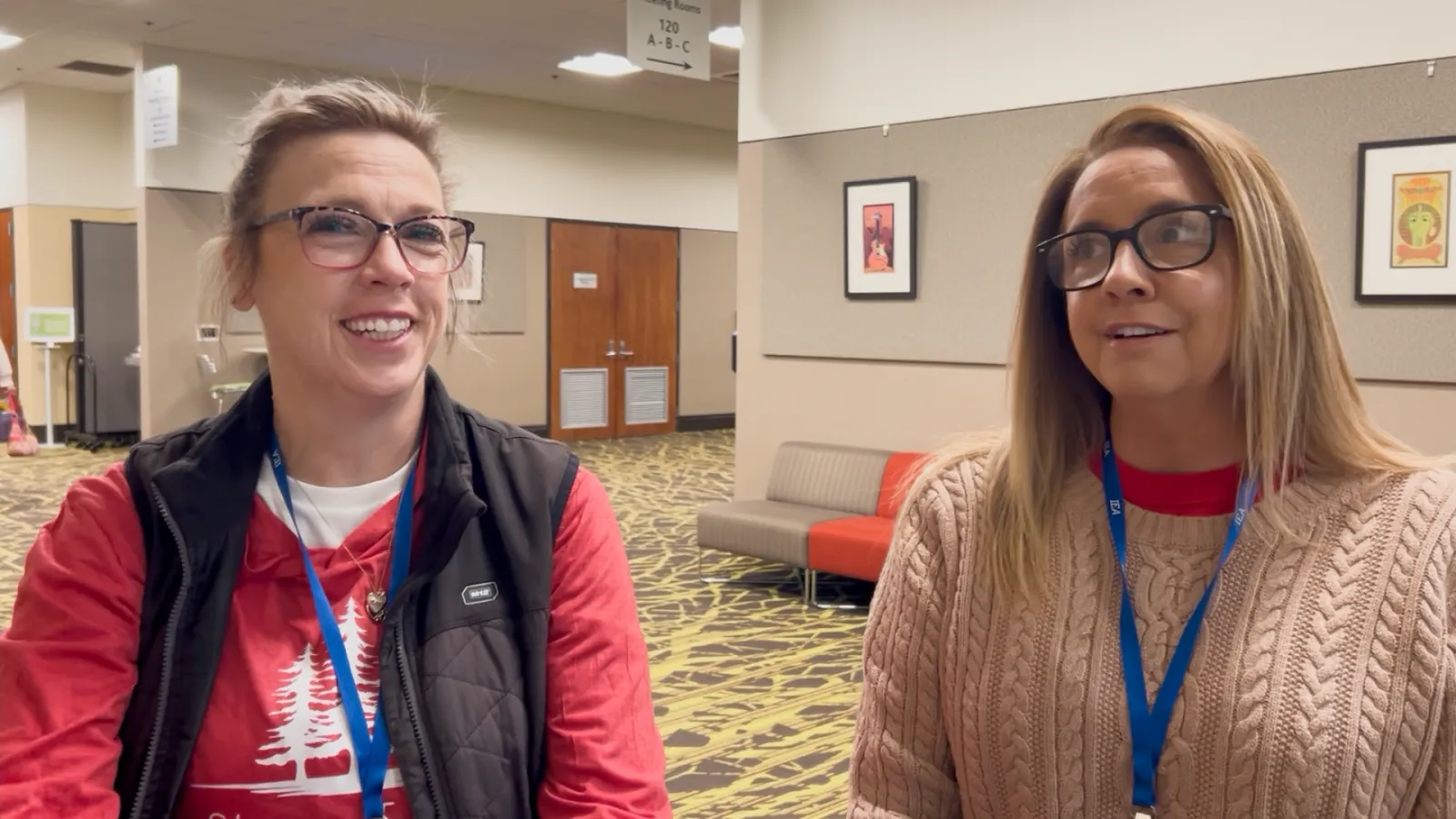
Kirk, left, and Delvalle sat down with IEA Reporter during Delegate Assembly to talk about their progress.
April 2025
Kirk — and her first recruit, district social worker Rachel Delvalle — were elected co-presidents of JEA later in 2024. Their path from non-unionized educators to JEA leaders was dizzying, yet they seemed to be taking it in stride when IEA Reporter spoke to them at the 2025 Delegate Assembly in April. Their conversation has been condensed and edited for this article.
IEA Reporter: Julie, last time I talked to you, which was in August, you were just getting started. Now you’re co-president. What happened?
Julie Kirk: I think we saw a need, and we had a vision that we wanted the union to be more visible and for people to know what we were doing and to help other teachers. I just decided that I can’t complain unless I’m going to do something about it, so I thought, “I guess I’ll run.”
IEA Reporter: What was the onboarding process like?
Julie Kirk: We kind of just got thrown into it! We started figuring stuff out. We knew we wanted to try to repair the relationship with the district office. That was our number one goal because we had gone through so much turmoil the year before.
IEA Reporter: What has the relationship with your superintendent been like?
Kirk: When he first reached out I was worried because I didn’t know if I was in trouble, because I am a little outspoken. But it was great! It was really great. He said, “I’ve heard that you lived here your whole life. You’ve taught here the whole time you’ve been a teacher. Tell me what Jerome means.”
Delvalle: He did that with community members and other teachers, too.
IEA Reporter: How has your own outreach been going?
Delvalle: One of the things Julie and I talk about is that we want to be visible, and we want people to know we’re out there for everyone. We’ve had a lot more chat-and-chews. The administrators have been great, letting us use cafeterias after school, and we just open up to questions. We’ve noticed that by doing that and going to them, we’ve got more people to buy into what we’re doing.
Kirk: Our building reps are way more active now, too, and we lean on them to get the word out about communication. We speak at staff meetings in each building and talk to everyone, not just members, and have a member meeting after that in a smaller classroom. I don’t think people in Jerome knew what the union did, and now they do because we’re more visible.
IEA Reporter: How is membership?
Kirk: Last time I looked, we had 93 members. I believe when I started it was 60. And people are still joining. The listening meetings bring in a lot of membership and curiosity. So we are growing our membership, but the most important thing is that we’re working as a team.
IEA Reporter: You attended Lobby Day this year. How did it go?
Kirk: I loved Lobby Day. Like, this is my jam. I don’t know how I went from not being a member to wanting to be on PACE and wanting to go talk to senators. I just feel like there’s so much more that you can do from the top. But you have to be smart with what you say, and careful with what you don’t say.
Delvalle: We did the collective bargaining series, too, and that was really helpful.
Kirk: And I went to the town hall (editor’s note: Kirk attended one of the town halls held after the Idaho Legislature passed House Bill 93, which created the private school voucher system). One hundred percent of the things that happened this session can’t happen again.
I was going to testify against the bill to track students’ immigration status. I thought, “No way can I talk in front of this committee. No way.” But I can’t complain if I don’t go do something about it. They killed the bill, so I didn’t have to, but I was ready.
Delvalle: We welcome all kids in our district and our district office and superintendent support that. In fact, we reached out to our superintendent and asked about Everyone is Welcome Here shirts. And he said, “Let’s put it out there!” We all got shirts made with Jerome colors on them.
We’ve seen students who are scared to come to school. We’ve had parents who wouldn’t let their children walk to school because they were afraid they were going to get picked up. In Jerome, we work with all kids, and it’s just that kind of community. I worry about those families. We have seen kids leave and not come back this year after Christmas, and it’s like, “Where’d that kid go? Where’d that family go?” So that has been heartbreaking.
Kirk: Every kid should feel welcome, and we’re all really on the same page.
Learn More
Read the Idaho Ed News story
Kirk Caught Up in Flag Ban
Although the district and educators were supportive of the Everyone Is Welcome Here movement, Julie Kirk still got caught up in Idaho's new flag-and-banner ban. She was reported after posting an Everyone Is Welcome Here sign on her classroom door, Idaho Ed News reported. Kirk told the news outlet, “I love my district and our administrators, and I would never want to take time or energy away from the many real and pressing issues we face in education. It is disheartening that a sign meant simply to reassure students that they are welcome has been turned into something political.”
September 2025
In August 2025, Kirk and Delvalle were too busy to sit down for an interview — they were dealing with the bus issue Kirk had first mentioned the year before. The Jerome School District had decided to bring busing in-house instead of outsourcing the service to a contractor, and the rollout did not go to plan. The district wound up canceling school for a portion of the first week back, and it took a few more weeks for the situation could right itself.
Kirk and Delvalle were able to make time to talk in September after the crisis had stabilized. They sounded experienced, ready to tackle issues — and busy. In just a year, they had made major moves toward their goals and had been re-elected as co-presidents.
Kirk’s goal was to repair the relationship between the Jerome School District and educators after the confusion and hurt feelings following the four-day workweek vote in 2024. She said they had made huge progress with Superintendent Brent Johnson.
“He wants to move forward. He wants to be positive. We’ve had some bumps in the road, but we have good, open communication. Nobody gets their feelings hurt. We just talk about what needs to be talked about and get it done.”
That open communication played a role in JEA’s last round of negotiations with the district. JEA made sure all types of educators — elementary, secondary, special ed — were represented at the table. JEA negotiated a 5% raise for everyone, as well as a 3% stipend for special education teachers and compensation for elementary school teachers who must use their prep time to cover for other educators, as well as other wins.
The prep time change required solidarity from educators around the district because middle school and high school educators had to make concessions so it could happen. That offered a lesson for Kirk, too.
“I get so wrapped up in my own building, and this is where I hear the most information from teachers, and I just really want to fight for them,” she said. “I really had to take a step back myself and make sure that I was representing not just the middle school.”
Quote byJulie Kirk, Jerome Education Association co-president
“Our motto for the Jerome School District is One Team, One Town, One Family. We preach that and we act on it, as well.”
—Julie Kirk,
Jerome Education Association co-president
Delvalle and Kirk were also learning the finer points of communicating with their members. Delvalle said members felt comfortable enough to come to them with issues, which felt like a win, but she had to learn not to choose her battles.
“I feel like I’m automatically a fixer because I’m a social worker,” she said. “I just want to fix it and move on. … We walk them through the steps in the process and listen to people. I think that’s the biggest piece.”
They also learned how to balance each others’ strengths and divide their duties. “I don’t know how unions do it with one president,” Kirk said. “Because it is a lot.”
The work was worth the effort, though, they said.
“I came in defensive because of the way it started,” Kirk said, referring to the four-day week debacle. “I wish I would have known it wasn’t always going to be a fight. There were so many good things!”
Kirk and Delvalle said they plan on keeping those good things going.
“We believe in the school district, we believe in our community, and we don’t want to see it crumble — the way education is going in the nation is not something that we want here in our little town,” Delvalle said. “We don’t want it to dry up. We want the Friday night lights on, and our whole school participating, our whole district participating. Being part of the union has been a huge part of that drive for us in our little town in our little corner of Idaho.”
Kirk agreed.
“Our motto for the Jerome School District is One Team, One Town, One Family,” she said. “We preach that and we act on it, as well.”
Take Action
Julie Kirk and Rachel Delvalle’s Tips for Union Presidents
Stay open to ideas. “You can’t have an agenda to do this job,” Kirk said. “You can have goals, but you can’t have your own agenda. You have to be open-minded, and you have to listen to people that you don’t necessarily agree with.”
Delegate, delegate, delegate. “Rachel and I both have strong personalities and we fix things,” Kirk said. “I’ve had to learn in the last year that I can’t fix everything. I don’t have to leave early and talk to such-and-such at the elementary school — I contact the building rep and trust that they will do it and call me if I need help.”
Be curious. “I’m a social worker in the school district, so I really have to spend time listening to teachers about the ‘why’ behind what they want,” Delvalle said. “We have to stay curious and understand their roles, because the roles are different.”
Find a partner. Both Kirk and Delvalle said a key piece of their success has been knowing each other’s strengths and playing to them. Delvalle is not a numbers person, for example, so Kirk is in charge of understanding budgeting issues. Delvalle takes on issues like special education because she is familiar with that world.
Get more from
Want more content? You can stay up to date on the latest with the IEA Reporter newsletter. Sign up to stay informed.

We are Idaho's public school educators.
As Idaho's largest labor union, we advocate for Idaho's education professionals and work to unite our members and the state to realize the promise of a public education that prepares every student to succeed. Together, our voice is stronger.