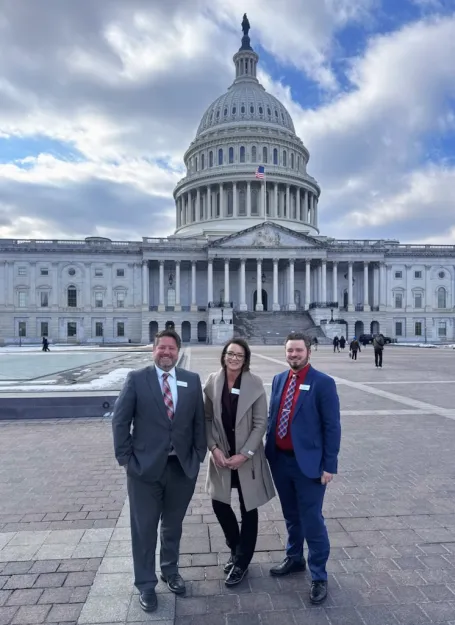
The big picture: Idaho Education Association’s governance team headed to Washington, D.C., this month to lobby the state’s congressional delegation about issues that directly affect Idaho educators.
Who went?: President Layne McInelly, Vice President Jon Hawkes and National Education Association Director Lindsey Smith lobbied on the Hill.
• IEA’s governance team makes the trip to D.C. multiple times every year to lobby.
What they advocated for: McInelly, Hawkes and Smith met with the offices of Sen. Jim Risch, Sen. Mike Crapo, Rep. Russ Fulcher, and Rep. Mike Simpson to discuss three things:
• Collective bargaining. Collective bargaining rights have been challenged in recent years across the country, including in Idaho. But as the governance team pointed out, collective bargaining is a proven way to create better working conditions and stronger collaboration between educators and districts.
• Safe schools and communities: The team urged lawmakers to keep immigration enforcement officials away from sensitive locations like schools, churches, and daycares, underscoring the need for students and families to experience safe learning environments.
• U.S. Department of Education: The department is roughly half the size it used to be, and Education Secretary Linda McMahon has advocated the dismantling of the agency, calling it “our department’s final mission.” For Idaho, IEA leaders pointed out, that risks handing education oversight and support over to departments lacking expertise or boots-on-the-ground knowledge. That could be a huge issue for the state’s rural schools, which have already encountered funding issues.
Why it matters: Federal decisions ripple into Idaho classrooms. In just one example, Idaho is grappling with a massive special education funding deficit in part because Congress has never fully funded the Individuals with Disabilities in Education (IDEA) Act.
Beyond lobbying: Smith participated in the NEA Board of Directors meeting and McInelly attended. The board guides the association between Representative Assemblies, similar to IEA’s own board structure.
The takeaway: Whether it’s on Capitol Hill or in the national union’s highest governing body, IEA leaders are showing up to make sure Idaho educators are heard where decisions are made.